
For too many years, I struggled with my mental health and almost died by suicide.
I had a depression that sapped my physical and mental energy and an anxiety that made life a very uncomfortable and difficult place to be. I felt miserable and my existence felt pointless which led me to the point of considering suicide.
Do you want to know the worst two things about all of this?
Firstly, I couldn’t understand what was going on with me. In my head, I had a great upbringing, I was physically healthy, able to study and work, and I had friends, but despite that I was feeling like death?
Secondly, a lack of understanding around mental health made me believe that there was something fundamentally wrong with me – a broken human being. This belief stripped away all my power and my hope that things could get better which ultimately prolonged my own suffering.
These day when I look back at my younger self I feel a great sense of sympathy for that version of me. I was a confused and hurt young man who found himself going down a really dark path due to no fault of his own.
At this point in my life, I had no understanding of mental health and how it related to me. It wasn’t something I was ever taught about either in school or in my home life. Instead, society made its mark and had moulded me into a traditionally masculine man.

I didn’t ‘believe’ in mental health, believing it to be a term used by weak people as excuse to be lazy. I saw myself as a ‘strong man’ and that meant I needed to be able to deal everything life threw my way, without needing anyone’s help. I thought that talking about emotions was something for women and I’d see other guys as being weak if they ever showed even just a hint of vulnerability.
At the same time, the amount of distressing thoughts in my head continued to multiply and next thing I knew I had started engaging in self-harming behaviours. This only added to my confusion – I couldn’t understand why on earth I’d want to hurt myself in the first place and why I couldn’t seem to stop?
This confusion turned into self-loathing. That critical voice grew even louder and I became my own worst enemy.
Before, I would just berate myself when I had done something really ‘stupid’ like harming myself or breaking something. But now, even small things, that you wouldn’t classify as a mistake, like spilling something or forgetting to reply to an email, would cause me to call myself every name under the sun.
The more I kept the distress and confusion to myself, the more intense the symptoms became until I eventually reached breaking point. I simply couldn’t keep going like this.
Long story short, over the next number of years I started on a journey of gaining support and working on understanding more about mental health and psychology and how it relates to me.
And although the first few years of ‘recovery’ (if you want to call it that) were some of the hardest of my life, I’m now in a position where I no longer struggle with these symptoms or have suicidal ideations. I’m far more self-aware, better able to look after my mental health and can more clearly understand the dangers of traditional masculinity and a lack of awareness around mental health.
My story is a powerful example of why things like Mental Health Awareness Week are SO important.
There are millions of people out there who need to improve their awareness of mental health and how it relates to them because having this understanding empowers people to take action, seek help and support and ultimately improve their wellbeing. If I had more knowledge and education around mental health, I’m in no doubt I’d have better understood what was going on inside my mind which would have allowed me to get help and support and ultimately recover sooner.
This year the theme of Mental Health Awareness Week is ‘Moving For Our Mental Health’ which I am delighted about.
There is a growing amount of evidence to demonstrate the positive impact of exercise on things like mood, stress, anxiety, energy, self-esteem and symptoms of poor mental health as well as cognitive abilities like learning, creativity, concentration, alertness and memory.
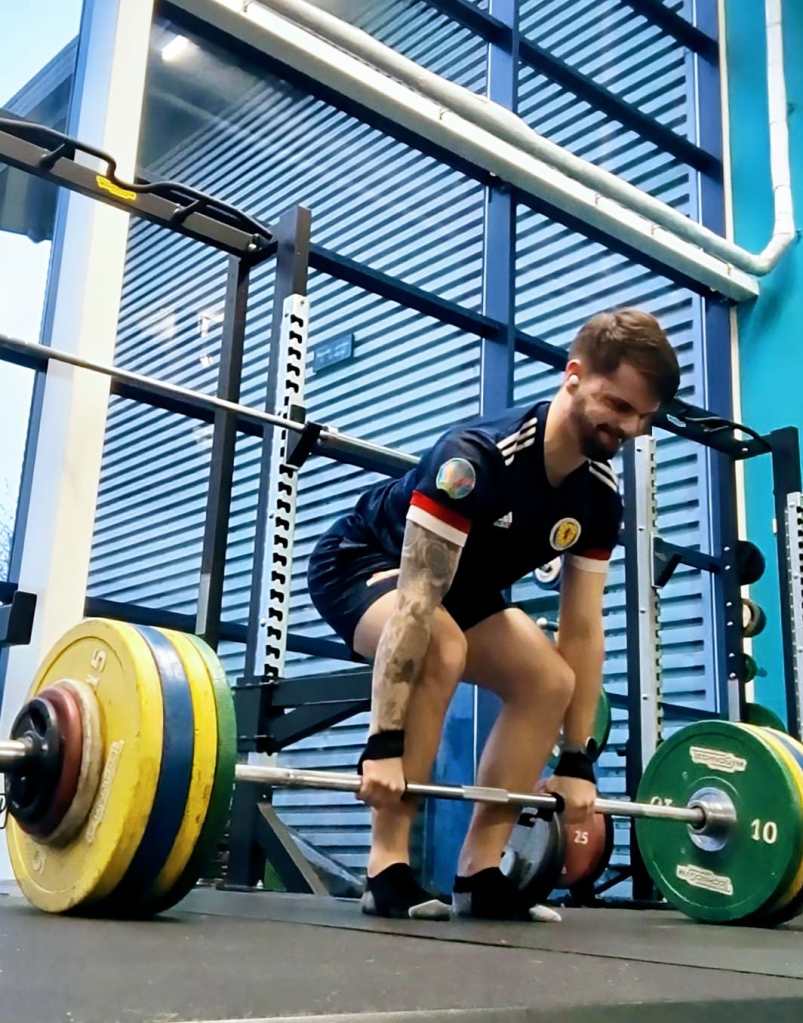
This is why I really push the message that exercise is as much for our mental health as it is our physical health.
At the end of the day, our physical and mental health are inseparable – they are part of the same system and influence each other. Therefore, it makes sense that when we engage in exercise it impacts our mental and physical health equally.
This wasn’t always my message though.
During this difficult period of my life, the only thing that seemed to take me out of my own head for a while was the gym and football. I know it may feel a little cringey or disingenuous to say that ‘the gym saved my life’ or whatever, but I genuinely question whether I’d still be here if it weren’t for the periods of respite that exercise offered me. The impact was massive.
But despite experiencing these incredible benefits on my mental health, I felt like I had to toe the line and do what I saw other PT’s doing; things like before and after pictures, tracking scale weight and using body fat callipers. It took me a long time to get the point of becoming aware that I didn’t have to do this and that this approach is actually very short-sighted.
The fitness industry has a long way to go in recognising this and in offering more support to those who are struggling with their mental health. It’s currently dominated by personal trainers and gyms offering ‘body transformations’ and ‘summer shreds’. As an industry, we are fixated on exercise as a tool for improving the physical alone.
When I first started my business back in 2018, I decided I wanted to help people struggling with their mental health to exercise more. Not just because I’ve been there myself and experienced the benefits, but because they are massively underserved in fitness and are a demographic who would hugely benefit from being enabled to exercise more.
With the busyness and responsibilities of life, it’s challenging enough for people who are in a good mental state to prioritise their exercise, never mind those who are struggling with depression, anxiety or other mental health challenges. For many in this boat, exercise feels like an impossibility.
It’s all well and good to tell people to ‘Move For Your Mental Health,’ but for some, this feels impossible to do this by themselves. That’s why I do what I do, to support people who find life a real challenge and help them boost their mental health through exercise.
It really can be life-changing or, as in my case, life-saving.

With all this in mind and in light of Mental Health Awareness Week…
The Strong Men are hosting a Movement Workshop on Sunday 26th May at Engage Sport and Fitness Centre, Edinburgh.
This session is designed to help men get moving and discover how movement and exercise can transform your mental wellbeing.
Not only will we cover a range of different movement to improve your mobility, strength, power and endurance, we’ll also dive into physical and mental training tools and strategies to maximise your progress and efficiency.
You can find out more about this event and book your space by clicking here
We would love to see you there!
 The Strong Men ™ - Men's Coaching